 |
||||
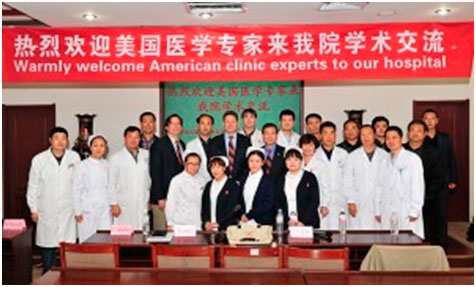
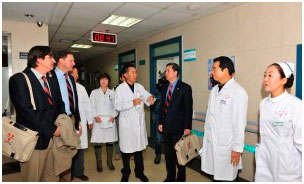
What’s New at UVA Orthopaedics?By Quanjun (Trey) Cui, MD Last fall, UVA Orthopaedics visited TangShan People’s Hospital and Dong E County People’s Hospital in China to formally begin the UVA Orthopaedics-Tong Kang International Scholarship Exchange Program.
Pictured from left to right In UVA orange-and-blue ties: During their visit to China, Drs. Cui, Diduch and Weiss visited TangShan People’s Hospital, the university-associated hospital, and Dong E County People’s Hospital, a community hospital. There, they organized and gave lectures and met with orthopaedic surgeons form many other hospitals. “The community hospital needs more knowledge,” says Dr. Cui. “China is developing quickly. Everything they do now is in wanting to catch up. We go there to teach, which is very helpful to close that knowledge gap. They want to close that gap. That’s what we’re helping them do. They also bring in a lot of international specialists from England, Germany and the United States in order to do this.” Dr. Weiss adds, “The UVA Orthopaedics-Tong Kang International Scholarship Exchange Program isn’t with just one institute. This program establishes relationships with a number of hospitals in China. This is the first time for this program. This is very special because UVA signed a formal contract for the next five years. We’ll be visiting at least once a year, for a week or ten days.” When asked what he learned on his visit, Dr. Weiss said, “It was very eye-opening for me. We have fellows who come here to study. Sure, there are some language barriers. They speak English, but it’s hard to know where they’re coming from, in a knowledge sense. It’s hard to know what they’re looking for. Also, it’s helpful to recognize the cultural aspects of medicine. Sometimes the choice of treatments you make as a doctor requires this consideration. For example, Dr. Diduch was presented with a possible ACL reconstruction. It’s common here in the U.S. for athletes. Yet, over there, at the county hospital, they do maybe 10 or 15 a year, because they don’t have the same level of sports, and their physical therapy is lacking. With an ACL reconstruction, the post-surgical therapy is critical to the treatment’s success. They won’t see the same success because there isn’t just the operation to consider, there’s the recovery. It’s the whole process involving a team, not just the surgeon.” Dr. Cui returns to China once a year to teach, but is excited at the prospect of this program. “The purpose of these trips is that we want to help,” he says. “China is still a developing country and they need the help. That’s why they want to send their surgeons here. If we don’t go, we don’t know what’s really going on. These visits allow us to help, and we learn from them, also. They have some creative stuff; a lot of clinical trials and surgical techniques not available here. It’s a wonderful learning process.” Dr. Diduch was humbled and surprised at how appreciative the Chinese physicians were. “They were fully engaged in learning all we could offer, through lectures, review of challenging cases, X-ray interpretation, seeing patients with them in the clinic or hospital, at every opportunity,” he says. “They were thirsty to share knowledge, and the exchange went both ways to be sure. Plus, we were treated like celebrities and ate like kings. It was a wonderful trip and I highly recommend that others go.” Dr. Cui notes that this exchange is a wonderful opportunity for collaboration. “Telemedicine is a huge market in China. We are still evaluating the opportunity with how we can cooperate, not only to promote a scholarship exchange, but also to help patients. This is a start. Their hospital is really updated. It’s a great facility. I was very surprised.” Dr. Weiss adds, “This exchange helps us get a better understanding of the culture. It’s helpful if we know where each other are coming from. They come here for up to a year. It’s quite an honor for them to be chosen to come here. We’re trying to better improve that culture of collaboration.” But, it was not all medicine and education for the visiting docs. There was some time to play tourist. “We did have time to visit cultural sites,” says Dr. Cui, “like tThe Forbidden City and the Great Wall. This was the first time for our guys visiting, to see the sites. We climbed Taishan mountain. It’s different from Yellowstone or Yosemite: They have a lot of buildings on the top of their mountains! It’s good to experience the culture and the food, and to meet with people.” Dr. Weiss agrees, saying, “We were very well fed. There were some excellent regional specialties. It was very different than Americanized Chinese food — it was really great.” When asked about the best part of the trip, Dr. Cui says, “You don’t know what kind of questions you will be asked to answer or cases you’re going to see. Intellectually, it’s exciting. We will definitely do it again!” Best Doctors 2015-2016, UVA Orthopaedics
UVA Adds Two Orthopedic Surgeons to Culpeper Hospital Campus University of Virginia Health System hired two orthopedic surgeons who work full-time at the newly opened UVA Orthopedics Culpeper to provide a range of specialized care, including sports medicine and joint replacements. Armin Harandi, MD, and Elisabeth Robinson, MD, are now seeing patents at the clinic, located on the UVA Culpeper Hospital campus at 541 Sunset Lane, Suite 303, in Culpeper.
|
||||
|
||||

Spring 2016
- PRESIDENT'S MESSAGE
- ANNUAL MEETING
- THANK YOU
TO OUR EXHIBITORS! - MEMBERS IN THE NEWS
- MEMBERSHIP INFO
- MEDICAL SCHOOL NEWS
- LEGISLATIVE NEWS
- DONATE TO OREF

VOS 69th Annual Meeting
April 15-17, 2016
Colonial Williamsburg

VIRGINIA ORTHOPAEDIC
SOCIETY

TO JOIN VOS
TO FIND A DOCTOR
IN YOUR AREA
TO RENEW YOUR DUES