
THE OFFICIAL NEWS PUBLICATION OF THE VIRGINIA ORTHOPAEDIC SOCIETY
CONTENTS OF THIS ISSUE

Winter 2018 Issue
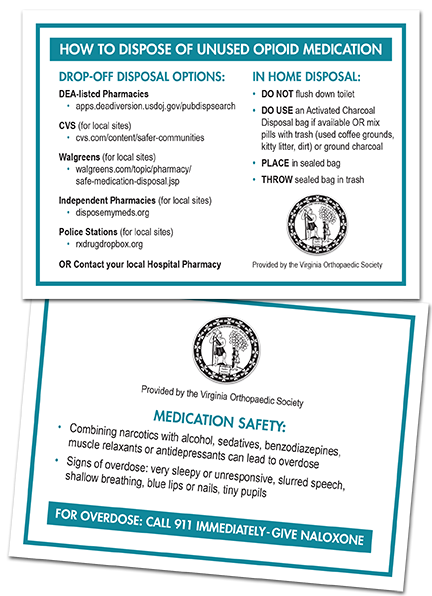


NEW Opioid Disposal Cards Available to VOS Members
The Virginia Orthopaedic Society (VOS), with a grant from the American Academy of Orthopaedic Surgeons (AAOS), has created opioid disposal handouts in pad form for VOS members to dispense with opioid prescriptions. The pads were created to inform patients about the correct disposal of unused opioid medications. If you are a current VOS member and would like to distribute these handouts, please email Andrew Mann, VOS Association Manager, at andrew@societyhq.com
Aligning Patient Needs and Provider Expectations Regarding Disposal of Unused Opioid Medications
By T.K. Miller, MD; Malek Bouzaher, BS, MS; Susan Giampalmo, BS; and Joseph T. Moskal, MD
In follow up to information presented in AAOS NOW, October 2017, through the support of a grant from the AAOS to the Virginia Orthopaedic Society, Carilion Clinic Orthopaedics and the Virginia Tech Carilion School of Medicine completed an investigational study with the goal of better understanding beliefs, perceptions and practices regarding methods of opioid medication disposal in Orthopaedic patients and providers in Southwest Virginia.
The primary goal of the study was to collect data that would lead to the development of patient-centric education materials detailing the rationale for safe disposal of unused opioids while also highlighting in-home and community-based options for disposal/return of unused narcotics, as well as the risks of medication “stockpiling” and drug diversion. The secondary intent was to align patients and providers perceptions and actions toward a common “best practice” goal.
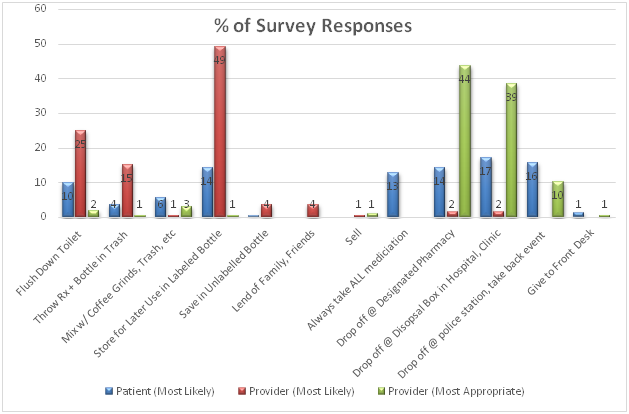
Of note was a disconnect in provider perception of patient intent for storage/disposal of unused opioids when compared to documented patients desires for safe practices to remove opioids and minimize risk of inadvertent diversion. This was compounded by limited institutional and community-based education and resource availability for the safe disposal or return of unused opioid medications
Figure 1: Comparison of Patient and Provider Responses to Disposal Options
-1.jpg)
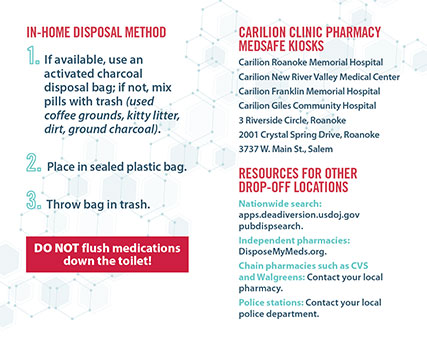
Recognizing that patient needs and intent aligned with best practice perceptions allowed the design of a patient-friendly, wallet-sized, institution-specific, educational handout to improve patient education. The information card is provided to all orthopaedic patients at the time of an opioid prescription, at the time of elective surgery scheduling and on discharge from outpatient or inpatient orthopaedic care.
This has been coupled with the expansion of secure medication disposal sites throughout the healthcare system (including remote sites of care that never had reliable access to a prescription drug disposal center), review of additional disposal options for office based sites of care and providing activated charcoal opioid neutralization/deactivation bags at the time of opioid dispensing at all system affiliated pharmacies.
 Thanks to that support of the AAOS, this may serve as an example how understanding the perspectives and practices of patients can assist providers and health care systems as they develop interventions that will be both accepted and used by the communities they serve.
T.K. Miller, MD, is a Professor of Orthopaedic Surgery at the Virginia Tech-Carilion School of Medicine and Vice Chair of Orthopaedic Surgery, Section Chief of Sports Medicine at Carilion Clinic.
Malek Bouzaher, BS, MS, is an MS3 student at the Virginia Tech-Carilion School of Medicine.
Susan Giampalmo, BS, is an MS3 student at the Virginia Tech-Carilion School of Medicine.
Joseph T. Moskal, MD, is a Professor of Orthopaedic Surgery at the Virginia Tech-Carilion School of Medicine and Chair of Orthopaedic Surgery, Section Chief of Adult Reconstruction at Carilion Clinic.
References
- Rudd RA, Seth P, David F, Scholl L: Increases in Drug and Opioid-Involved Overdose Deaths — United States, 2010–2015. MMWR Morb Mortal Wkly Rep. ePub: 16 December 2016.
- CDC: Wide-ranging online data for epidemiologic research (WONDER). Atlanta, GA: CDC, National Center for Health Statistics; 2016. Available at http://wonder.cdc.gov.
- SAMSHSA, C for B.H.S. and Q. (2015). RESULTS FROM THE 2014 NATIONAL SURVEY ON DRUG USE AND HEALTH; DETAILED TABLES PREVALANCE ESTIMATES, STANDARD ERRORS, P VALUES AND SAMPLE SIZES. Retrieved from https://smamhsa.gov/data/sites/default/files/NSDUH-DetTabs2014/NSDUH-DetTabs2014.pdf.
- Bicket MC, Long JJ, Pronovost PJ, Alexander GC, Wu CL: Prescription opioid analgesics commonly unused after surgery: A systematic review. JAMA Surg Published online Aug 2, 2017.
- Kumar K, Gulotta LV, Dines JS, et al: Unused opioid pills after outpatient shoulder surgeries given current perioperative prescribing habits. Am J Sports Med 2017;45(3):636-641.
- FDA, US Food and Drug Administration. https:// www.fda.gov./Drugs/ResourcesForYou/Consumers.
- McCauley JL, Back SE, Brady KT: Pilot of a brief, web-based educational intervention targeting safe storage and disposal of prescription opioids. Addict Behavior 2013;38(6),2230-2235.
- Cicero TJ, Ellis MS, Surratt HL, Kurtz, SP. The Changing Face of Heroin Use in the United States: A Retrospective Analysis of the Past 50 Years. JAMA Psychiatry. 2014;71(7):821-826
- Madras BK. The Surge of Opioid Use, Addiction, and Overdoses: Responsibility and Response of the US Health Care System. JAMA Psychiatry. 2017;74(5)441-442.

THE VOS NEWSLETTER IS AVAILABLE ON YOUR SMART PHONE AND TABLET

Get the FREE VOS Membership App From
 |
 |
 |


JOIN VOS TODAY!


PLAN NOW!
VOS 72nd |
 |
May 3-5, 2019 |
| The Intercontinental at the Wharf |
| Washington, DC |